
Metaverse

 The Metaverse is a collective virtual shared space, created by the convergence of virtually enhanced physical reality and physically persistent virtual space, including the sum of all virtual worlds, augmented reality, and the Internet. The word "metaverse" is made up of the prefix "meta" (meaning beyond) and the stem "verse" (a backformation from "universe"); the term is typically used to describe the concept of a future iteration of the internet, made up of persistent, shared, 3D virtual spaces linked into a perceived virtual universe 


Metaverse


Devlopment of Metaverse 

The term was coined in Neal Stephenson's 1992 science fiction novel Snow Crash, where humans, as avatars, interact with each other and software agents, in a three-dimensional space that uses the metaphor of the real world. Stephenson used the term to describe a virtual reality-based successor to the Internet. Concepts similar to the Metaverse have appeared under a variety of names in the cyberpunk genre of fiction as far back as 1981 in the novella True Names. Stephenson stated in the afterword to Snow Crash that after finishing the novel he learned about Habitat, an early MMORPG which resembled the Metaverse.
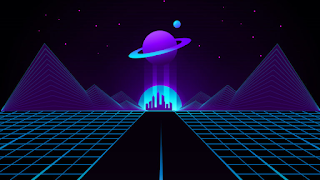
Metaverse


The concept was made famous under another term, cyberspace, which first appeared in the short story 'Burning Chrome' by William Gibson (Omni, July 1982) and was a central theme in his 1984 groundbreaking novel, Neuromancer. Since cyberspace has now, through common use, become a term that simply means the Internet, Metaverse is the preferred term[citation needed] for the concept of a virtual shared space that converges with actual reality. Unlike, for instance, in the fictional concept introduced in Neuromancer, which was typified by a Cartesian separation of body and mind, the Metaverse allows its users to access its environs but still aware of their mundane world surroundings. This is demonstrated in a technology called invisible to visible (I2V) that Nissan is developing, which overlays a car's windshield with virtual information as well as features that include an ability to summon an in-car 3D avatar.

Since many massively multiplayer online games connecting millions of players share features with the Metaverse but only provide access to non-persistent instances of virtual worlds that are shared only by up to several dozen players, the concept of multiverse virtual worlds has been used to distinguish them from the Metaverse.


Comments

Popular posts from this blog

what if we don't have a brain

  The brain is the most complex and important organ in the human body. The brain is made of soft nervous tissues which control all body functions. It is the center of the nervous system in all invertebrates and vertebrates. It is located in the head and functions as the coordinating center of intellectual, sensation and the nervous system. So can we live without a brain? Well, let’s see if it’s possible or not. The brain is divided into two parts: the cerebrum and the cerebellum. The cerebrum controls important functions like our learning ability, emotion, etc. while on the other hand, the cerebellum controls activities such as balance and our muscle movements, etc. But the brain also determines our personality. There are several cases that show that a brain trauma can change someone’s personality. But back to our main question which is “Can we live without a brain?” To understand this, let us look at a case. In 2014, a 24 years old Chinese woman complained in a hospital about her ...

Kardashev scale

  The   Kardashev scale   is a method of measuring a  civilization ' s level of technological  advancement based on the amount of energy  it is able to use. The measure was proposed by   Soviet    astronomer   Nikolai    Kardashev    in 1964. The scale is hypothetical , and regards energy consumption on a cosmic  scale. Various extensions of the scale have since been proposed, including a wider range of power levels (types 0, IV through VI) and the use of metrics other than pure power. Categories  The Kardashev scale has three designated categories, these are: A  Type I civilization , also called a planetary civilization , can use and store all of the energy available on its planet.  A  Type II civilization , also called a stellar    civilization , can use and control energy at the scale of its planetary system. A  Type III ...

What is butterfly effect ?

 In chaos theory, the butterfly effect is the sensitive dependence on initial conditions in which a small change in one state of a deterministic nonlinear system can result in large differences in a later state. The term is closely associated with the work of mathematician and meteorologist Edward Lorenz. What is butterfly effect in simple terms ? The  butterfly effect  is an idea that is more commonly used in chaos theory. A small change can make much bigger changes happen; one small incident can have a big impact on the future. The idea started from weather prediction. ... This  term  can be used in areas other than weather. What is butterfly effect theory ? The  butterfly effect  is the idea that small things can have non-linear impacts on a complex system. The concept is imagined with a  butterfly  flapping its wings and causing a typhoon. Of course, a single act like the butterfly flapping its wings cannot cause a typhoon. IS butte...